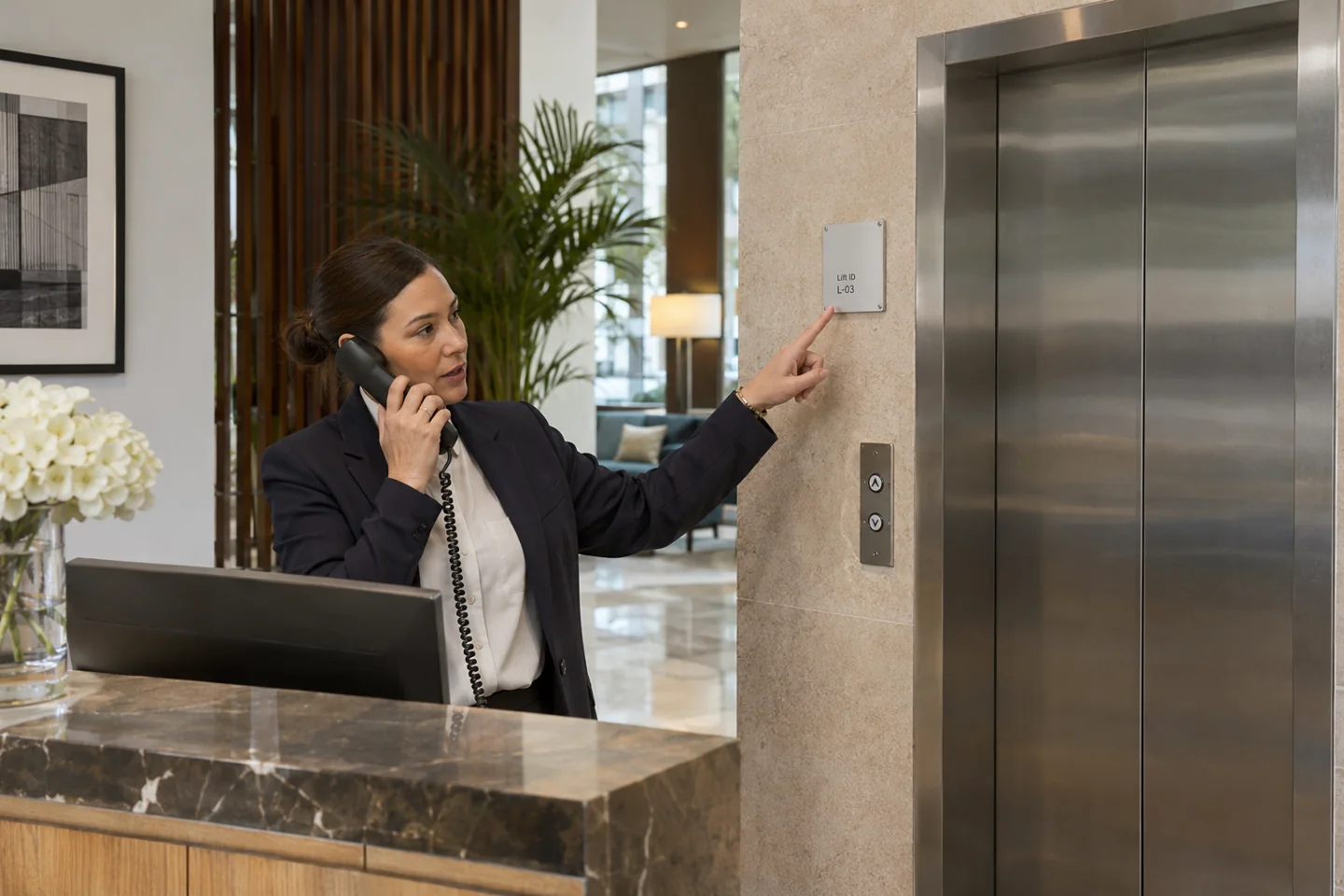
When a lift develops a fault, a clear report helps the service team understand what needs assessment. Tell them where the lift is, what you observed and when it happened. A short, accurate description is more useful than guessing which component needs replacing.
This guide helps building owners and managers prepare an enquiry for lift repair in Karachi. It is not a repair procedure: the equipment needs assessment before a diagnosis, parts list or repair price can be confirmed.
Describe what happened, rather than diagnosing it
Report the observable problem: a door not closing, a cabin stopping unevenly, an unexpected stop, a displayed error or an unusual sound. Say whether the complaint happened once or has been recurring. Note the affected landing and the time of the latest incident if known.
If an error display or existing record can be photographed from a normally accessible area, share it with the team. Do not enter restricted equipment spaces or interfere with the lift to collect information. If you do not know an answer, mark it as unknown.
- What was the lift doing when the problem appeared?
- Which floor or door was involved?
- Did the same problem happen previously?
- Was any fault code displayed?
- Has any recent repair or other change been recorded?
Include the building and equipment details
Send the exact site location, a building contact and access arrangements. State whether it is a passenger, home or cargo lift, and provide the make, model and service history where available. For a goods lift, include the rated load from existing equipment records.
For sites in DHA, Clifton, Korangi Industrial Area, SITE Area or another Karachi locality, include the area in the first message. This allows Shinkai to discuss availability and the next step for that location. A message does not itself confirm a technician booking or arrival time.
Ask for a clear assessment and quotation
Before agreeing the work, ask how the visit or assessment is charged and what the quotation will cover. A reported symptom can have different causes; a suggested replacement should follow the equipment assessment.
| Item | Question to ask |
|---|---|
| Findings | What fault was identified, and what work is proposed? |
| Parts | Which parts, quantities and compatible specifications are included? |
| Labour and visit | Are assessment, labour, transport and any return visit separately charged? |
| Timing | What depends on parts availability or access to the building? |
| Completion | What checks and written work record will be provided? |
| Terms | What payment, warranty and exclusion terms apply to this repair? |
Keep a record after the repair
Keep the original complaint, assessment, accepted quotation and completed-work record together. Record the date, affected lift, work carried out and any replacement components. If the same symptom returns, this history gives the next technician useful context without assuming the cause is unchanged.
Recurring complaints also deserve a conversation about preventive lift maintenance and AMC. A maintenance contract is a separate scope of work; check which visits, call-outs and parts are included. Our service-record guide explains how to organise this history.
A message template for a repair enquiry
Karachi area and building: [location]
Lift type and make: [passenger/home/cargo; make if known]
Fault observed: [what happened and affected floor]
Latest occurrence: [date/time if known]
Previous work: [recent service or repair record]
Site contact and access: [contact and suitable arrangements]
Call 0304 3083143 or send a repair enquiry on WhatsApp. The team confirms technician availability, visit arrangements and the proposed next step.